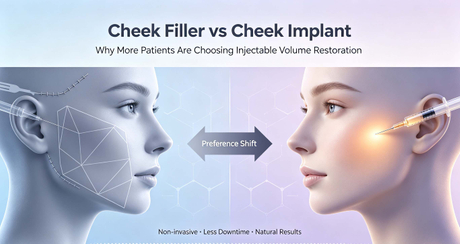
The worldwide move to minimally invasive facial aesthetics is no longer a trend but a structural change in patient demand and clinical practice. This transition is most noticeable in the area of cheek lifts, as the traditional surgical implant procedures are increasingly being replaced by injectable cheek fillers. For clinics, distributors or aesthetic practitioners, it is no longer an option, but an essential part of remaining competitive to understand the clinical and commercial rationale of this transition.
In this article, we will present a detailed comparison of the pros and cons of both cheek implants and injectable fillers, review the clinical evidence for volume restoration with hyaluronic acid and discuss why patients and the clinics serving them are increasingly opting for non-surgical options. We will also share real-world success stories from AOMA’s global partners and showcase how AOMA supports business growth with high quality products and comprehensive OEM/ODM capabilities for partners who want to establish or expand their business in this rapidly growing sector.
Cheek lift: The never-ending quest for facial volume
Cheek augmentation is one of the most favourite aesthetic procedures across the globe. With ageing, the natural volume of the midface is reduced by atrophy of deep and superficial fat compartments, resulting in a hollowed, gaunt appearance that disrupts the harmony of the face. The global cheek augmentation market was valued at $4.56 billion in 2025 and is projected to reach $7.28 billion by 2031, growing at a CAGR of 8.11% from 2022 to 2031. Driven by increasing patient preference for minimal downtime and reversibility, the non-surgical segment, led by injectable fillers, is becoming the fastest-growing segment within this growing market.
This growth means real business opportunities for B2B buyers and aesthetic practitioners. The important question is not whether to provide cheek volume restoration, but rather how to best perform it for patients.
Cheek Implants Versus Cheek Fillers: What’s the Difference
Surgical Prostheses: The Cost of Permanent Structural Integration
Traditional cheek implants are solid, biocompatible devices, usually silicone, surgically placed over the cheekbones through an intraoral incision. The main benefit of these devices is that they are designed to be permanent – that is, once implanted they are there to stay until they are surgically removed. These implants provide dependable structural projection and are particularly helpful in patients with congenital midface hypoplasia or significant skeletal deficits.
However, there are some big drawbacks. The procedure is performed under local or general anaesthesia, and takes 60 to 90 minutes with a one to two week recovery period before normal activity can be resumed. Swelling after surgery can take months to resolve completely. There are surgical risks that patients may experience such as infection, nerve damage, scarring, and asymmetry. Furthermore, the volume of the face changes constantly over the years; bone resorption, loss of fat and thinning of the skin can all have an impact on the long-term aesthetic outcome of permanent implants, sometimes necessitating additional procedures that defeat the purpose of a “permanent fix”.
Cheek Fillers: A Flexible Option for Restoring Volume
Injectable fillers are a whole other animal. Instead of changing the underlying skeletal structure through surgery, they replace the lost volume by augmenting the soft-tissue layers of the mid-face. Hyaluronic acid (HA) is the gold standard of the various filling materials available for mid-face lifting due to its safety, reversibility and natural feel. The fillers used for mid-face volume filler can be injected with either blunt cannulas or sharp needles and the procedure can take about 30 minutes with most patients returning to normal activity within 24 hours.
The aesthetic advantage of injection volumization is its adaptability. While the fixed nature of an implant can feel unnatural, a well-designed injection that enhances the cheekbone augmentation injection with the natural anatomy of the face, creating a three-dimensional contour that preserves the fluidity of facial expressions. This is precisely why more and more aesthetic practitioners now offer cheek lifting with injectable treatments alone.
Clinical Evidence: Why Patients Love Volumising Fillers
The preference for non-surgical cheek lifting is based on clinical evidence as well as the convenience of the procedure. Injectable solutions for facial rejuvenation continue to dominate the field, with the American Society of Plastic Surgeons reporting 5,331,426 treatments with HA fillers in the year 2024 alone.
Durability used to be a major point for surgical implants, but today’s crosslinked HA formulations boast much better durability. A split-face study in <Plastic and Reconstructive Surgery> investigated volumetric changes in the anteromedial cheek 2 years after HA filler injection. Results showed that monophasic HA fillers retained 81% of their volume at the two year mark versus the four week post-treatment baseline while biphasic fillers retained over 50%. Both types of HA fillers were superior in terms of efficacy, safety and longevity in cheek volumization. Practitioners can show patients these permanent changes with the help of 3D imaging, researchers said.
With regard to safety, the most comprehensive review of complication rates for fillers demonstrated that HA fillers have the lowest incidence of serious adverse events, such as nodules (2%), vascular events (0.2%), and granulomas (0%), and is a clear advantage over other biostimulatory materials. Injectable volume restoration for the midface is a very low risk procedure due to the positive safety profile and reversibility of HA fillers with hyaluronidase.
Injectable Cheek Fillers Help AOMA Partner Change Business Real-World Success Story
“AOMA’s global partners tell us time and again that the introduction of injectable cheek volumization has been a game changer for their practices. Consider Dr Maria Santos, who owns a mid-sized aesthetic clinic in São Paulo, Brazil. Dr. Santos had previously focused on providing surgical cheek implants for mid-face rejuvenation. The revenue per procedure was high, but the patient volume was limited and the cost, recovery time, and surgical risks kept many potential clients away.
Dr Santos partnered with AOMA in 2024 to launch a volume restoration filler protocol with our premium line of HA dermal fillers. Now the clinic is doing an average of 35 to 40 cheek-filler treatments per month, as opposed to two or three surgical implant procedures, she said. Patient satisfaction exceeds 95 percent and most patients cite the minimal downtime and natural results as the deciding factor. Additionally, the decreased cost per injection treatment greatly expanded her potential patient base, which resulted in a 62% increase in the clinic’s total revenue in the first year of implementation.
“Shifting to Injectable Cheek Volumization has revolutionised how we perform our work for our patients,” says Dr. Santos. Today, we can offer facial rejuvenation to patients who would never have considered surgery. “My patients like the fact that the procedure is quick, comfortable and reversible and AOMA fillers produce consistent, predictable results. “From a business perspective, the repeat visit model generates a sustainable recurring revenue stream that our surgical practice never had.
This model of high patient volume, high profit and repeat treatment based is a very attractive business opportunity for distributors and clinics. The key to success lies in collaborating with a reputable facial volume fillers factory, which can guarantee a steady supply of high-quality products that comply with international regulatory standards.
Commercial Value of Volume Restoration with Injectables
For medical aesthetic clinics, the business case for switching from surgical implants to injectable fillers is more than about patient preference. Injectable treatments do not require operating rooms, anaesthesia teams, sterilisation equipment or overnight observation for operational reasons. This reduces the cost per procedure significantly, and increases the throughput of the clinic, allowing practitioners to see more patients in less time.
Surgical implants are a large, one-time payment, whereas injectable volume restoration fosters a continuing treatment relationship. Hyaluronic acid (HA) fillers typically need to be maintained every 12 to 18 months, leading to repeat visits and predictable, recurring revenue. Many clinics have been able to successfully convert this treatment cycle into a subscription-based membership model, further stabilising cash flow and increasing patient loyalty.
The rising demand for non-surgical cheek lifting offers a lucrative growth opportunity for the distributors. As clinics switch away from implant-based procedures, demand for quality dermal fillers remains strong. To capitalise on this demand, the key is to partner with a reputabledermal filler distributor supplier who can provide quality products, a reliable supply chain and competitive price point.
AOMA: Your Go-To Partner in Cosmetic Injections
Since 2003, AOMA is a leading manufacturer of hyaluronic acid fillers, with more than 23 years of experience supporting more than 580 brands in 120 countries. We have a 4,800 square metre GMP-certified pharmaceutical manufacturing plant with three dedicated production lines, manufacturing 500,000 units of sodium hyaluronate gel products per month. “We spend more than 10% of our annual revenue on research and development. We have more than 18% of our employees engaged in research and development. We have five senior experts in sodium hyaluronate gel technology with more than 21 years of specialised experience.
We have a full range of aesthetic solutions in our product portfolio. Our cheek filler line is designed for mid-face lifting and projection, offering a non-surgical cheek implants, providing immediate volume with reversible and adjustable results, offering the benefits of structural enhancement without the risks of surgery. Our mid-face volumising filler range offers a range of viscosities for deep supraperiosteal support, mid-layer volumising and correction of superficial fine lines – the ultimate solution for clinics seeking to rejuvenate the face. We also have specialised volumising formulations that are formulated to treat age-related mid-face volume loss or facial hollowing after weight loss.
Besides our already extensive product line, AOMA also provides full HA volumizer OEMincluding logo and packaging design, custom formulation development, volume specifications and custom packaging. With over 1,000 proven formulas and an OEM/ODM production turnaround of just 2-3 weeks, we help aesthetic brands and distributors bring their private-label products to market faster than ever. All products are produced under strict quality control, using hyaluronic acid raw materials from the US ($45,000/kg) and B&D syringe parts, guaranteeing the best quality in every step of production.
AOMA is an ISO 13485 certified facial volume filler factory which complies with CE and FDA regulations, and ensures regulatory compliance and product traceability at all levels of the supply chain. Our satisfaction rate is 99.5% and our repurchase rate is 96% and we’ve achieved this across 54 countries, which is a testament to the reliability and effectiveness of our products in the real world of clinical use.
Conclusion
The results are clear: injectable volume restoration is now the preferred method of cheek lift for patients and practitioners alike. The advantages of injectable products over surgical implants in terms of commercial benefits are: improved safety profiles, less downtime, natural and adjustable results and the opportunity to build long-term relationships with patients. The question is not if clinics, distributors, and aesthetic brands should go into the injectable cheek-lifting market, but how to go into it with the right partner.
With 20 years of manufacturing experience, internationally recognised quality certifications and a broad product portfolio including HA fillers, body contouring solutions and biostimulators, AOMA is uniquely positioned to assist your business in this fast-growing sector. Whether you are a clinic looking for reliable clinical products, a distributor building a competitive aesthetic portfolio or a brand preparing to launch your own private label, AOMA delivers the quality, consistency and partnership necessary for your success.
For more information about our complete range of dermal fillers for volume loss or to discuss your OEM/ODM needs, please contact our team. Let's shape the future of the medical aesthetics industry together.
Dr. Emily Carter (MD, Fellow of the American Academy of Dermatology) is a board-certified cosmetic surgeon in New York City with over 9 years of specialized experience in hyaluronic acid fillers, acne scar treatment, and minimally invasive facial contouring. She is particularly recognized for her expertise in advanced injectable therapies that effectively lighten acne scars, promote skin healing, and restore smoothness through targeted skin repair injection and skin booster techniques.