Mesotherapy is a minimally invasive technique that delivers active ingredients directly into the dermal layer to address skin aging, hyperpigmentation, and hydration. This article examines the regional adoption trends of mesotherapy, compliance requirements, and its clinical efficacy for industry professionals in the global aesthetic market.

Regional Market Analysis And Driving Factors
Market demand for mesotherapy varies significantly by region, influenced by cultural preferences, regulatory environments, and economic factors. The following analysis outlines key trends across major markets.
North America: Demand For Evidence-Based And Standardized Treatments
●Core Viewpoint: The North American market prioritizes clinical validation, product safety, and natural-looking results.
●Supporting Trends: Growth is driven by rising demand for skin rejuvenation, with a compound annual growth rate (CAGR) projected at approximately 8-12% through 2025. Treatments targeting specific areas like the neck, hands, and décolletage are gaining popularity.
●Key Drivers: Strict FDA oversight encourages standardized, medical-grade formulations. High disposable income supports premium, preventative aesthetic procedures. A cultural preference for subtle, gradual enhancement over dramatic change shapes treatment protocols.
Europe: A Mature Market With a Focus On Holistic And Natural Approaches
●Core Viewpoint: As the historical origin of mesotherapy, Europe represents a mature market where combination therapies and natural ingredients are highly valued.
●Supporting Trends: The market shows steady growth, with a strong focus on combining mesotherapy with energy-based devices (e.g., lasers, radiofrequency). There is increasing demand for products designed for sensitive skin and those offering protection against environmental stressors.
●Key Drivers: A well-established medical aesthetic culture and regulatory framework centered on the CE marking system. Consumer awareness and demand for sustainable, "clean" ingredient profiles influence product development.
Asia-Pacific: The Fastest-Growing Region With Distinct Efficacy Demands
●Core Viewpoint: The APAC region is characterized by rapid growth and specific demands for brightening, hydration, and porcelain-like skin texture.
●Supporting Trends: This region is expected to maintain the highest global CAGR, exceeding 15-20% in leading markets like South Korea, China, and Japan. "Aqua-glow" or "glass skin" effects are primary treatment goals, making hydrating and brightening formulations dominant.
●Key Drivers: A vast consumer base, high social media influence on beauty standards, and a tech-savvy population that readily adopts new aesthetic procedures. Regulatory pathways, while diverse, are generally becoming more stringent.
Latin America & Middle East: Strong Demand For Contouring And Pronounced Results
●Core Viewpoint: These regions show high demand for body contouring and treatments that deliver visibly transformative, strong results.
●Supporting Trends: Markets are expanding rapidly, with particular interest in mesotherapy for localized fat reduction and robust anti-aging protocols. Post-procedure soothing and repair products are also essential due to climatic conditions.
●Key Drivers: Significant disposable income allocated to aesthetic enhancements and cultural norms that favor pronounced, noticeable results. Adapting to warmer climates necessitates specific post-treatment care protocols.
Compliance And Safety: The Critical Pathway To Market Access
Product safety and regulatory compliance are non-negotiable prerequisites for market entry and long-term success. Each region enforces distinct regulatory frameworks.
The European Union: The CE Marking Mandate
●Core Requirement: The CE mark is legally mandatory, indicating conformity with EU health, safety, and environmental standards under the Medical Device Regulation (MDR).
●Compliance Path: Products are classified by risk (Class I, IIa, IIb, III). Manufacturers must prepare a comprehensive technical dossier and undergo a conformity assessment, often involving a Notified Body.
●2025 Outlook: Enhanced post-market surveillance and stricter requirements for clinical evidence are expected, reinforcing the need for rigorous documentation.
The United States: FDA Dual Oversight
●Core Requirement: Mesotherapy solution products are regulated as drugs, devices, or combination products by the U.S. Food and Drug Administration (FDA).
●Compliance Path: Most injectables require pre-market approval (PMA) or 510(k) clearance. Demonstrating safety and efficacy through clinical data is paramount. Manufacturing facilities must comply with Current Good Manufacturing Practice (cGMP).
●2025 Outlook: The FDA is likely to provide more explicit guidance on the regulatory classification of combination products to clarify submission pathways.
Asia-Pacific: Diverse and Evolving Regulatory Landscapes
●Core Requirement: Each major market operates its own stringent regulatory agency.
●Compliance Path:
South Korea: Approval from the Ministry of Food and Drug Safety (MFDS) is mandatory, with increasing demands for local clinical data.
Japan: Pharmaceuticals and Medical Devices Agency (PMDA) approval governs the market.
●Common Trend: A universal tightening of regulations against non-compliant and counterfeit products is observed across the region.
Universal Safety Benchmarks (2025)
Adherence to the following global standards is essential:
●Sterility Assurance: Compliance with ISO 13485 for quality management and validated sterilization processes.
●Ingredient Transparency: Full disclosure of composition and concentration. Undeclared components are prohibited.
●Clinical Validation: Key performance claims must be supported by data from controlled clinical studies.
●Post-Market Vigilance: Implementation of a systematic Pharmacovigilance (PV) system for adverse event monitoring and reporting.
Establishing Credibility Of Clinical Efficacy
Clinical trust is established through transparent communication, standardized processes and safety commitments. The therapeutic effect must be associated with specific therapeutic goals in order to be accurately evaluated. At present, the mesotherapy for skin rejuvenation demand continues to grow worldwide, which requires practitioners not only to provide effects but also to establish a systematic trust system.
Treatment Forms and Targeted Applications Of Mesotherapy
The choice of treatment methods should be based on the client's skin condition and specific needs. This reflects the actual situation of regional differences in mesotherapy adoption. For instance, consumers in the Asian market usually prefer whitening and hydrating programs.
Select according to the conveying mode:
●Microneedling: This method uses microneedle devices to create tiny channels on the skin surface and is suitable for treating large areas of epidermal problems, such as superficial acne marks and fine lines.
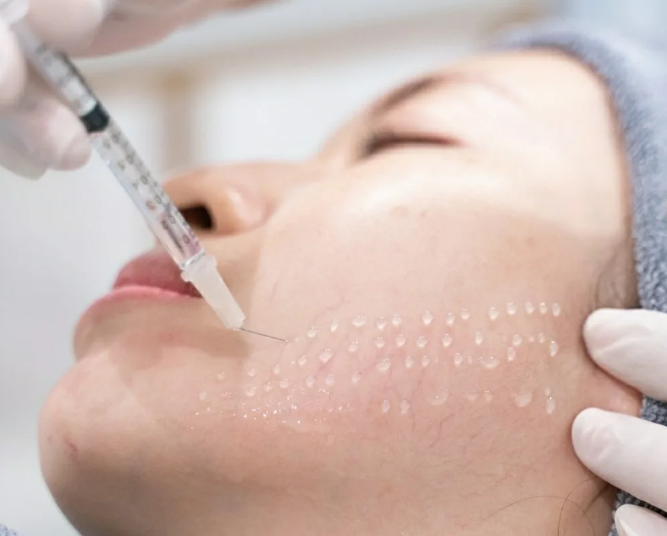
●Injection-based Mesotherapy: The active ingredients are precisely introduced into the dermis through a meplastic gun or a water light meter. This method has a remarkable effect on deep hydration and improving skin structure.
●Needle-free / Jet Mesotherapy: Ingredient introduction is achieved through techniques such as electroporation or high-pressure air flow. This method causes less pain and has a short recovery period, making it suitable for customers who are sensitive to pain or afraid of needles for basic maintenance.
Select based on product efficacy
Clinicians should choose products with corresponding functions based on specific skin problems. A scientific compounding scheme can achieve synergistic enhancement.

●Hydrating and Moisturizing Series: Addressing issues such as dry skin, dehydration, and impaired barrier function. The core components usually include hyaluronic acid of different molecular weights, as well as amino acids, vitamin B5, etc.
●Whitening and Brightening Series: Designed to improve uneven skin tone, dullness and pigmentation. Effective formulas usually contain ingredients such as tranexamic acid, glutathione, L-vitamin C and niacinamide, which inhibit melanin through multiple pathways.
●Firming and Anti-aging Series: Used to improve skin laxity, wrinkles and decreased elasticity. Such products often contain polypeptides, growth factors, non-cross-linked hyaluronic acid and vitamins A/C/E to stimulate the regeneration of collagen. This directly responds to the market demand for the visual effect of mesotherapy facial rejuvenation before after.
●Repair and Regeneration Series: Suitable for sensitive skin, postoperative repair and skin barrier reconstruction. The core ingredients include epidermal growth factor, polydeoxynucleotides and ceramides, etc., aiming to accelerate healing and reduce inflammation.
●Lipolysis and body shaping series: Used for non-surgical methods to improve local fat accumulation. The clinically verified effective component is the scientific ratio of phosphatidylcholine and deoxycholic acid, and the operation must be strictly standardized.
Practical Methods For Building Long-Term Trust
The establishment of trust runs through the entire customer service process and requires a systematic approach.
●Implement transparent consultation: Before treatment, tools such as anatomical diagrams and component descriptions should be used to clearly explain the principle, expected effect, treatment course and potential risks.
●Follow standardized procedures: Establish a complete set of standard operating procedures from customer assessment, protocol formulation, aseptic operation to postoperative care.
●Conduct effect tracking: Before and after each treatment, professional photography should be carried out under standardized conditions, and key data should be recorded using a skin detector to establish a long-term file.
●Select reliable partners: Suppliers should be able to provide complete global compliance documents (such as CE marking for mesotherapy products), clinical data support and clear guidelines for handling adverse events. This is directly related to the professional reputation and operational security of the institution.
Industry Future and Strategic Choices
Outlook on Core Development Trends
Looking at mesotherapy market trends 2025, the industry will present the following directions:
●Product standardization and evidence-based practice: Products that meet medical-grade standards and production norms will become the market foundation.
●Personalized treatment: Customized solutions that combine genetic testing with AI skin analysis will be more widely applied.
●The normalization of combined therapy: The integration of mesotherapy with projects such as optoelectronics will become the enhanced treatment option chosen by over 70% of customers.
Suggestions For Industry Participants
●For service institutions: It is necessary to build a product system covering multiple functions, continuously invest in professional education for personnel, and adopt digital tools to manage the customer journey and efficacy tracking.
●For distributors: Suppliers with full-chain compliance capabilities and stable quality systems should be selected, and a localized training and education support system should be established.
Product selection criteria: The compliance (especially the CE marking for mesotherapy products), scientificity (whether there is clinical data support), stability (batch consistency) and the support degree of the supplier should be examined primarily.
Addressing Challenges: The Value of Partners
In the face of global compliance, efficacy and supply chain challenges, it is crucial to establish reliable partnerships according to dermal injections industry outlook 2025.
As a solution provider with over 20 years of industry experience, AOMA is committed to being a trusted partner. Our solution focuses on core challenges:

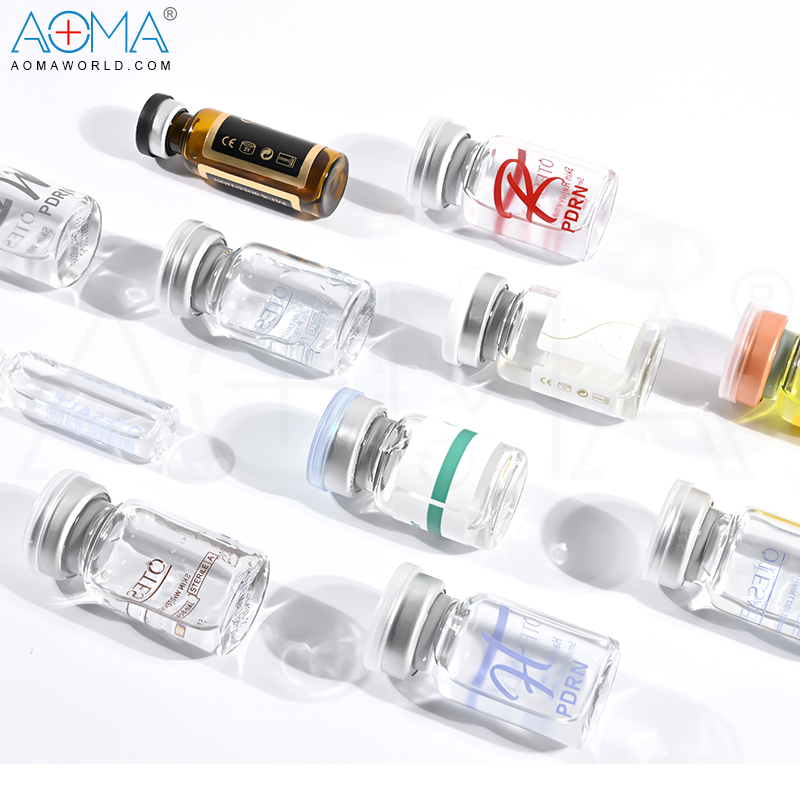
●Provide compliance guarantee: Key product lines have qualifications such as CE marking for mesotherapy products, and complete documentation support is provided.
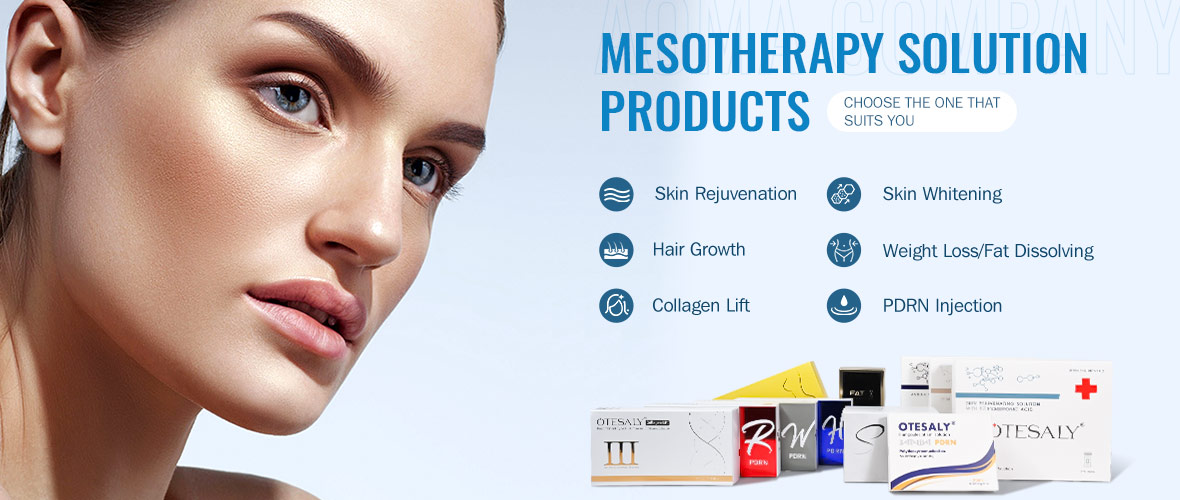
●Develop a scientific product matrix: The product series is designed for the demand of mesotherapy for skin rejuvenation, covering multiple needs such as anti-aging, whitening, fat dissolving and repair.
●Ensure support and stability: While ensuring the reliability of the supply chain, provide application guidance and technical support based on clinical consensus (including considerations of mesotherapy safety guidelines 2025).
Conclusion
The global adoption of mesotherapy is defined by clear regional preferences and universally rising standards for safety and proof of efficacy. Success in this market requires a dual focus: Understanding local demand drivers and adhering to the highest global compliance benchmarks. For clinics, distributors, and practitioners, partnering with scientifically grounded, fully compliant product suppliers is the foundational strategy for sustainable growth and patient safety.
This analysis is based on a synthesis of current market research, regulatory publications, and clinical literature on mesotherapy. Treatment protocols must be administered by qualified professionals in accordance with local medical regulations.