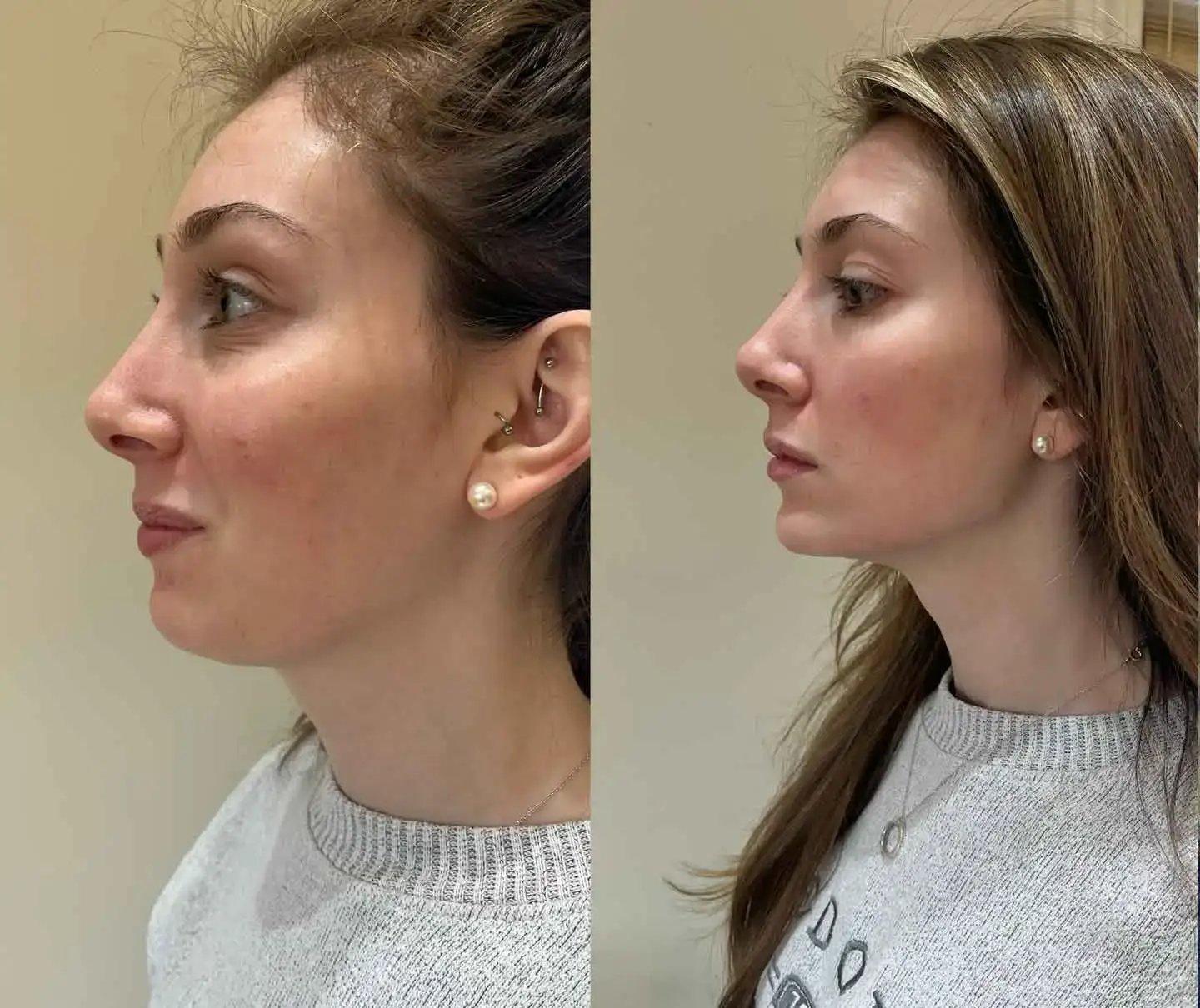
Filler isn't only about lips. Some of the most transformative — and most natural — results come from structural filler: restoring cheek volume, sharpening a jawline, or balancing a profile with chin filler. Because these areas carry the scaffolding of the face, the right treatment can lift and define without looking "done." Here's how cheek, jawline, and chin filler work, what to expect, and how to choose.
Why structural filler matters
With age, the face loses volume and bone support from the top down — flatter cheeks, a softer jawline, a less-defined chin. This is why an aging face can look tired or heavy even with good skin. Restoring support in the cheeks, jaw, and chin can lift the midface, sharpen the lower face, and rebalance a profile — often more rejuvenating than treating lines directly.
Cheek filler: the midface lift
Cheek filler restores volume to the upper face, subtly lifting everything below it — the basis of the "liquid facelift" concept.
Best for: flattened cheeks, midface volume loss, an indirect lift to nasolabial folds.
Effect: more contour and youthful projection; a lifted, rested appearance without surgery.
Jawline filler: definition and structure
Jawline filler sharpens a soft or undefined jaw and can improve the appearance of early jowling. It's increasingly popular with men as well as women — a defined jaw is one of the most requested structural results in modern aesthetics.
Best for: soft or undefined jawline, mild jowling, overall lower-face definition.
Note: the jaw breaks down filler faster than most areas due to constant movement (talking, chewing), so longevity is typically shorter here.
Chin filler: balance and profile
Chin filler balances a recessed chin, improves the side profile, and refines chin-to-lip proportion. Done well, it can even make the nose look more proportionate — without touching the nose.
Best for: recessed or short chin, profile imbalance, weak chin-to-lip ratio.
Unlike lips or under-eyes — which need soft, low-viscosity gels — cheeks, jaw, and chin usually need a firmer, more structural HA filler with strong lift capacity. A cohesive, higher-viscosity gel injected deep (often placed close to bone) provides the scaffolding these areas need to hold shape. For a more gradual, longer-lasting approach, biostimulators like PLLA build structural volume by stimulating collagen over months — which can complement or in some cases replace structural HA in the right patient. Details in our guide to biostimulator injections and PLLA.
Results, longevity & cost
Results: immediate with HA filler, settling fully over one to two weeks as swelling resolves. Most people look natural from the start — the main "surprise" is how different correct structural placement feels compared to adding volume in the wrong plane.
Longevity: structural areas hold well. Cheeks commonly last 12–18 months; chin filler is often on the longer end; jawline filler can break down faster due to movement. Firmer, higher-density gels and proper deep placement both support longevity.
Cost: structural areas often need more product per session than lips or fine lines. Always ask the total cost including how many syringes are included, not just a per-syringe price — it's the only way to compare quotes fairly.
The safety facts for structural areas
Cheeks, jawline, and chin are all FDA-approved facial areas for dermal fillers. According to the FDA's guidance on soft-tissue fillers, fillers are approved for increasing fullness in the cheeks, jawline, and chin, among other facial areas — provided an FDA-approved product is used and administered by a trained, licensed healthcare provider.
Structural areas are also zones where technique matters most. Deep placement near bone, close to nerves and blood vessels, demands an experienced injector — not the place to optimize for price over expertise. As with all HA fillers, reversibility with hyaluronidase is an important safety backstop.
Sourcing structural HA fillers for clinics and brands
Structural facial areas demand a product with the right firmness and lift capacity — not all HA gels perform the same way here. AOMA's HA dermal filler range includes Derm, Derm Plus, and Subskin grades with varying viscosity and cohesivity, covering everything from fine-line correction to deep structural placement in cheeks, jaw, and chin — produced to medical standard with CE, ISO 13485, and SGS certification. Private-label customization of formula, packaging, and branding is available for clinics, distributors, and brands.
Sourcing structural HA fillers for your clinic or brand?Request a quote and product catalog for product grades, specifications, MOQ, and private-label options.
FAQ
What filler is best for cheeks? A firm, structural HA gel injected deep — or a PLLA biostimulator for a more gradual, longer-lasting collagen-building approach. The right choice depends on the degree of volume loss and the patient's goals.
How long does jawline filler last? Typically 9–14 months in the jaw — shorter than cheeks or chin because jaw movement (talking, chewing) breaks filler down faster.
Is chin filler safe? Yes, when administered by a trained, licensed injector using an FDA-approved HA product. The chin is an approved filler area; the main risks come from incorrect technique or unqualified providers.
Can filler replace a facelift? No — filler restores volume and can improve contour, but it can't address excess skin laxity the way surgery can. It's best for patients with volume loss rather than significant skin sagging.
Can men get cheek and jawline filler? Absolutely — structural filler is increasingly common among men. The goals tend toward angularity and definition rather than softness, which a skilled injector accounts for in placement.
Dr. Emily Carter (MD, Fellow of the American Academy of Dermatology) is a board-certified cosmetic surgeon in New York City with over 9 years of specialized experience in hyaluronic acid fillers, acne scar treatment, and minimally invasive facial contouring. She is particularly recognized for her expertise in advanced injectable therapies that effectively lighten acne scars, promote skin healing, and restore smoothness through targeted skin repair injection and skin booster techniques.