People looking up the differences between Ozempic and Wegovy often assume the two names describe one product. Both contain semaglutide, a GLP-1 receptor agonist from Novo Nordisk, and both are injected once a week. That is where the similarity ends: they are approved for different purposes, studied at different doses and intended for different patients. This guide sets out those differences from official labels and major trials. It is not medical advice. Any prescribing decision belongs with a licensed clinician and the local product information.
Same Active Ingredient, Two Licensed Medicines
Semaglutide mimics GLP-1, a gut hormone that helps regulate appetite, gastric emptying and insulin secretion. That is why both medicines can lower blood sugar and reduce body weight, and why they carry similar safety warnings. For more on the molecule, see Understanding Semaglutide Injection and Its Uses.
A shared active ingredient does not make two licensed medicines the same product. Ozempic and Wegovy have separate approvals, dose schedules and presentations. The US labels for both state that they should not be used together, or with another semaglutide-containing product or any other GLP-1 receptor agonist.
Different Purpose: What Each Medicine Is Approved For
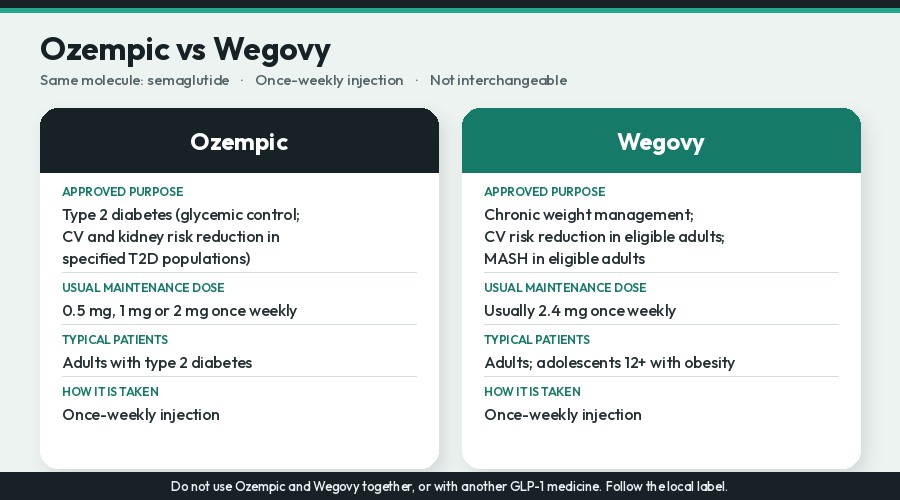
According to the US prescribing information for Ozempic, it is indicated to improve glycemic control in adults with type 2 diabetes (as an adjunct to diet and exercise); to reduce the risk of major adverse cardiovascular events in adults with type 2 diabetes and established cardiovascular disease; and to reduce the risk of sustained eGFR decline, end-stage kidney disease and cardiovascular death in adults with type 2 diabetes and chronic kidney disease.
The US prescribing information for Wegovy is different. Used with a reduced-calorie diet and increased physical activity, Wegovy injection is indicated to reduce the risk of major adverse cardiovascular events in adults with established cardiovascular disease and either obesity or overweight; to reduce excess body weight and maintain weight reduction long term in adults and adolescents aged 12 years and older with obesity, and in adults with overweight plus at least one weight-related comorbid condition; and, under accelerated approval, for noncirrhotic metabolic dysfunction-associated steatohepatitis (MASH) with moderate to advanced liver fibrosis in adults.
In the European Union, Ozempic is authorised for adults with insufficiently controlled type 2 diabetes, while Wegovy is authorised for weight management in adults with a BMI of 30 or higher, or 27 or higher with weight-related health problems, and in adolescents from 12 years of age with obesity. Ozempic is not approved for chronic weight management. Weight can fall during diabetes treatment, but using it solely for weight loss is off-label and is not equivalent to Wegovy.
Dose and Titration: Why 2 mg Is Not 2.4 mg
Both injections usually start at 0.25 mg once weekly and increase every four weeks to improve gastrointestinal tolerability. For Ozempic, the dose rises from 0.25 mg to 0.5 mg after four weeks; if additional glycemic control is needed, it may increase to 1 mg after at least four weeks on 0.5 mg, and then to 2 mg after at least four weeks on 1 mg. The maximum recommended weekly dose is 2 mg. For the kidney indication, the label directs an increase to 1 mg once weekly after at least four weeks on 0.5 mg.
For Wegovy injection, titration typically runs 0.25 mg, 0.5 mg, 1 mg and 1.7 mg, each for four weeks, toward a usual maintenance dose of 2.4 mg once weekly. If a step is hard to tolerate, escalation can be delayed, and many labels allow 1.7 mg as maintenance when 2.4 mg is not tolerated.
Both are injected subcutaneously in the abdomen, thigh or upper arm, on the same day each week, with or without meals. The pens and presentations are not interchangeable, even at an overlapping milligram strength: a 1 mg Ozempic dose is not a substitute for a Wegovy titration step.
In December 2025 the US also approved a once-daily Wegovy tablet (oral semaglutide 25 mg) for adult weight management. It is not the same product as the weekly injection, or as Rybelsus, the oral semaglutide tablet for type 2 diabetes. This comparison focuses on the weekly injections people usually mean by "Ozempic vs Wegovy."
Ozempic vs Wegovy at a Glance
Ozempic
Wegovy injection
Active ingredient
Semaglutide
Semaglutide
Main approved purpose (US)
Type 2 diabetes: glycemic control, plus cardiovascular and kidney risk reduction in specified populations
Chronic weight management; cardiovascular risk reduction in adults with established CVD and obesity or overweight; MASH in eligible adults
Starting dose
0.25 mg once weekly
0.25 mg once weekly
Usual maintenance dose
0.5 mg, 1 mg or 2 mg once weekly
Usually 2.4 mg once weekly (1.7 mg may be used if 2.4 mg is not tolerated)
Population highlights
Adults with type 2 diabetes
Adults; adolescents aged 12 years and older with obesity for the weight-management indication
Used together?
No. Do not combine with another semaglutide product or another GLP-1 receptor agonist.
What the Evidence Shows
Dedicated obesity trials of the 2.4 mg dose provide the main weight-loss evidence. In STEP 1, adults with overweight or obesity without diabetes lost a mean 14.9% of body weight on semaglutide 2.4 mg weekly, versus 2.4% with placebo, at 68 weeks (Wilding et al., N Engl J Med 2021).
Ozempic's pivotal program (SUSTAIN) was designed around glycemic control. Weight often falls in those trials, but average loss is typically smaller than in obesity studies of 2.4 mg, because the approved maintenance doses go only to 2 mg and many participants had type 2 diabetes. There is no large head-to-head weight-management trial of Ozempic 2 mg versus Wegovy 2.4 mg.
Cardiovascular results also come from different populations. In SUSTAIN-6, semaglutide 0.5 mg or 1.0 mg reduced major adverse cardiovascular events versus placebo in adults with type 2 diabetes at high cardiovascular risk (hazard ratio 0.74; Marso et al., N Engl J Med 2016). In SELECT, semaglutide 2.4 mg reduced those events by 20% (hazard ratio 0.80) in adults with overweight or obesity and established cardiovascular disease without diabetes (Lincoff et al., N Engl J Med 2023). The kidney indication for Ozempic is supported by the FLOW trial of semaglutide 1 mg in type 2 diabetes and chronic kidney disease (Perkovic et al., N Engl J Med 2024).
Safety and Side Effects: More Alike Than Different
Because the active ingredient is the same, the safety profiles overlap closely. Both US labels carry a boxed warning about thyroid C-cell tumors in rodents; it is unknown whether this risk applies to humans. Both are contraindicated in people with a personal or family history of medullary thyroid carcinoma or with Multiple Endocrine Neoplasia syndrome type 2 (MEN 2).
The most common side effects are gastrointestinal — nausea, vomiting, diarrhea, constipation and abdominal pain — and are often most noticeable during dose escalation. Labels also discuss pancreatitis, gallbladder disease, acute kidney injury from volume depletion, severe gastrointestinal reactions, hypoglycemia when used with insulin or a sulfonylurea, and complications of diabetic retinopathy in people with diabetes, who should be monitored. Seek urgent care for severe, persistent abdominal pain, a serious allergic reaction, or warning signs of dehydration, gallbladder trouble or kidney problems. Switching from one semaglutide product to the other is not a reliable way to escape a class-related side effect.
Are They Interchangeable? Switching, Coverage and Shortages
No. The same molecule does not mean the same labelled use, dose or coverage. Insurance and reimbursement often follow the indication, so the two products are frequently treated as different benefits. During past shortages, some patients were prescribed Ozempic off-label for weight loss, which tightened supply for people who need it for diabetes and is not a substitute for the indicated product.
Diet and physical activity remain part of both labels. Substantial weight loss can also change facial volume. "Ozempic face" is a popular name for that leaner look and can appear with Wegovy or other effective weight-loss medicines as well. Clinics that offer volume restoration can read more in Ozempic Face: Causes and Dermal Fillers.
Prescription incretin therapy should stay under medical supervision, with authorised products rather than unregulated lookalikes. AOMA does not manufacture or sell Ozempic or Wegovy. It is a Hangzhou-based OEM/ODM manufacturer of medical-aesthetic and weight-loss injectables, with CE, ISO 13485, GMP and FDA certificates. MOQ starts from 200 units, stock orders ship within 24 hours, and OEM lead time is 2–3 weeks after artwork, formula and packaging are confirmed.
FAQ
Are Ozempic and Wegovy the same drug?
They contain the same active ingredient, semaglutide, but they are not the same licensed medicine. Ozempic is approved for type 2 diabetes and related cardiovascular and kidney risk reduction; Wegovy is approved for chronic weight management and, in specified groups, for cardiovascular risk reduction and MASH.
Can I use Ozempic for weight loss?
Ozempic is not approved for chronic weight management. Weight loss can occur during diabetes treatment, but using it only for weight loss is off-label. Wegovy is the semaglutide product studied and approved for that purpose.
Why is the Wegovy dose higher?
Wegovy was developed for weight management, with a usual maintenance dose of 2.4 mg once weekly. Ozempic was developed for type 2 diabetes and has a maximum recommended dose of 2 mg once weekly. The schedules are not interchangeable just because both start at 0.25 mg.
Can I take Ozempic and Wegovy together?
No. Labels advise against using either medicine with another semaglutide product or another GLP-1 receptor agonist, and you should not switch without a licensed prescriber.
Medical Disclaimer
This article is for general education. It is not medical advice. Ozempic, Wegovy and Rybelsus are prescription-only medicines. Any change in therapy must be decided by a licensed prescriber according to the local label. AOMA does not manufacture or sell these products. Ozempic, Wegovy and Rybelsus are trademarks of Novo Nordisk A/S.
References
OZEMPIC (semaglutide) injection, US Prescribing Information. Novo Nordisk. DailyMed. https://dailymed.nlm.nih.gov/dailymed/drugInfo.cfm?setid=adec4fd2-6858-4c99-91d4-531f5f2a2d79
WEGOVY (semaglutide) injection, US Prescribing Information. Novo Nordisk. DailyMed. https://dailymed.nlm.nih.gov/dailymed/drugInfo.cfm?setid=ee06186f-2aa3-4990-a760-757579d8f77b
Wilding JPH, Batterham RL, Calanna S, et al. Once-weekly semaglutide in adults with overweight or obesity. N Engl J Med. 2021;384(11):989-1002. PMID: 33567185.
Marso SP, Bain SC, Consoli A, et al. Semaglutide and cardiovascular outcomes in patients with type 2 diabetes (SUSTAIN-6). N Engl J Med. 2016;375(19):1834-1844. PMID: 27633186.
Lincoff AM, Brown-Frandsen K, Colhoun HM, et al. Semaglutide and cardiovascular outcomes in obesity without diabetes (SELECT). N Engl J Med. 2023;389(24):2221-2232. PMID: 37952131.
Perkovic V, Tuttle KR, Rossing P, et al. Effects of semaglutide on chronic kidney disease in patients with type 2 diabetes (FLOW). N Engl J Med. 2024;391(2):109-121. PMID: 38889252.
Dr. Emily Carter– United States
Dr. Emily Carter (MD, Fellow of the American Academy of Dermatology) is a board-certified cosmetic surgeon in New York City with over 9 years of specialized experience in hyaluronic acid fillers, acne scar treatment, and minimally invasive facial contouring. She is particularly recognized for her expertise in advanced injectable therapies that effectively lighten acne scars, promote skin healing, and restore smoothness through targeted skin repair injection and skin booster techniques.